Nous utilisons des cookies pour améliorer votre expérience. Pour nous conformer à la nouvelle directive sur la vie privée, nous devons demander votre consentement à l’utilisation de ces cookies. En savoir plus.

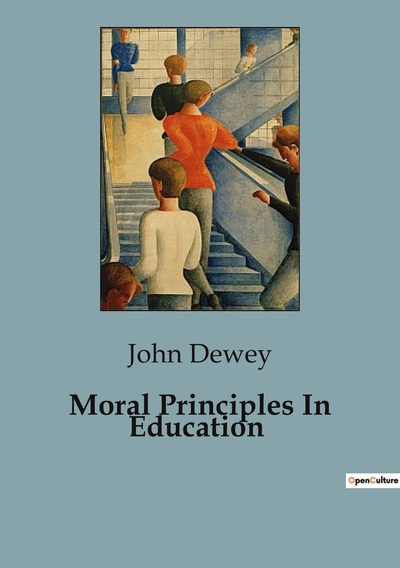
Moral Principles In Education
EAN : 9791041823451
Édition papier
EAN : 9791041823451
Paru le : 3 nov. 2023
12,00 €
11,37 €
Disponible
Pour connaître votre prix et commander, identifiez-vous
Notre engagement qualité
-
 Livraison gratuite
en France sans minimum
de commande -
 Manquants maintenus
en commande
automatiquement -
 Un interlocuteur
unique pour toutes
vos commandes -
 Toutes les licences
numériques du marché
au tarif éditeur -
 Assistance téléphonique
personalisée sur le
numérique -
 Service client
Du Lundi au vendredi
de 9h à 18h
- EAN13 : 9791041823451
- Réf. fournisseur : 315976
- Date Parution : 3 nov. 2023
- Disponibilite : Disponible
- Barème de remise : NS
- Nombre de pages : 28
- Format : H:210 mm L:148 mm E:2 mm
- Poids : 52gr
- Résumé : In "Moral Principles in Education," John Dewey explores the integral role of moral education within the school system, emphasizing its social and psychological dimensions. Dewey argues that education is fundamentally a public endeavor, with schools serving as vital social institutions that shape the moral character of students. He critiques the traditional separation of intellectual and moral training, advocating for a more integrated approach where moral education is embedded in all aspects of school life. Dewey highlights the importance of the school community in fostering moral development, suggesting that schools should mirror the social order to prepare students for active participation in society. He stresses that moral education should not be limited to direct instruction about ethics but should permeate the entire educational experience, influencing methods of instruction and the curriculum. Dewey also underscores the need for education to develop students' social intelligence, power, and interests, aligning with the demands of a democratic and progressive society. He calls for a curriculum that reflects social realities and encourages students to engage with the world around them, fostering habits of social imagination and cooperation. Dewey concludes by emphasizing the psychological aspects of moral education, advocating for an approach that nurtures students' instincts and impulses, develops their judgment, and enhances their emotional responsiveness. Through this comprehensive framework, Dewey envisions an educational system that not only imparts knowledge but also cultivates the moral and social capacities necessary for students to thrive as responsible and engaged citizens.
- Biographie : John Dewey (1859.1952) was an influential American philosopher and educator, central to the development of pragmatist philosophy and progressive education. After graduating from Johns Hopkins University, he taught at the University of Chicago and Columbia University, developing ideas that bridged philosophy, psychology, and social reform. His works, including « Human Nature and Conduct » (1922) and « Democracy and Education » (1916), revolutionized pedagogy by advocating for experiential learning and intelligence as tools for democratic empowerment. Dewey promoted an ethics grounded in empirical facts and envisioned a society where collective habit and critical intelligence work together to solve social problems. Recognized as the father of modern education, his legacy continues to influence pragmatist philosophy, social sciences, and movements for social justice.